中EN
Buy the Accepted Best, Hold Long Enough
Buying stocks is lending, with a company's shares as the collateral; so buy only the widely accepted blue chips, don't time the market, and lend enough for long enough that compounding actually shows up in your account.
1. Buying stocks is, in fact, lending
Everything I've said so far has been leading up to this one line: buying stocks is, in fact, lending. It's just that the form has changed.
This is how we should understand it: buying stocks on a securities market is, at its core, lending to a company. Only the collateral is no longer property or factories, but the company's shares.
So this is a new kind of loan: a combined secured-and-credit loan.
Does the company put up collateral? Yes — its shares. And they're more liquid than property.
So why must you buy the stocks that are widely accepted as the best?
2. Why "widely accepted" matters
Why does "widely accepted" matter? Because modern financial markets live under the rule of law, and laws and regulations are far more complete than they were 100 years ago. The financial information of good companies and big companies is public and transparent, and everyone knows which ones are the best.
So when it comes to buying stocks, we are different from the people out there. Everyone knows which companies are accepted as the best — there's even a word for them: "blue chips." We just buy the accepted blue chips, and that's it.
A blue chip's productive ability has already been proven; it isn't a hope. These companies have been tested, they are the most productive, and we just buy them directly.
What else is there to research? Why go digging through a garbage heap looking for gold? Others rack their brains, the smartest people in the world are all fighting it out — and we simply step aside.
This also explains why Buffett favors companies with a long enough track record — without enough years of financial statements, you can't judge their productive ability.
3. Collateral has to be sellable
There's one more detail: the collateral has to be liquid enough, otherwise it's extremely dangerous. Blue chips and big companies are highly productive, and collateral like that is bound to be more liquid.
Let me add a word here: why have I grown more and more dismissive of investing in real estate? Because real estate is far too illiquid — you can't exactly tear out the bathroom and sell it on its own.
For an investment, a lack of liquidity is fatal. That's also why, when the assets of high-net-worth individuals are counted internationally, antique collections and real estate are left out, because both are very illiquid.
4. Don't pick the stock, don't pick the time
We don't need to pick the stock, because everyone knows which ones are best.
And one more thing: we don't pick the time either — any time is a fine time to get in. I'll explain not timing the market in detail later, when we get to the dollar-cost averaging strategy; for now I'll leave it at one line.
5. Lend enough, for long enough
Next, what else does a lender need to think about? If you want a big harvest, as a lender you have to understand this: you need to lend enough, and lend for long enough.
If it isn't a big company, I can't lend it very much; if it isn't a company that has proven it will be around for the long term, I can't lend to it for long enough.
From this angle, you can understand why Buffett has managed a compound annual return of about 20% over the past fifty or sixty years. He favors consumer stocks. I agree — he's right. Because only consumption is eternal and can never die out. That's also why Coca-Cola became one of the most famous companies to stay listed for over a hundred years.
6. If you don't hold for the long term, you're not lending
Once you truly take in this obvious conclusion — "buying stocks is lending" — you'll realize another fact that should have been just as obvious but never occurred to you: if you buy stocks as a lender but don't hold them for the long term, you're not lending.
Why? Because the fundamental reason lending is so profitable is compounding. When does compounding show up? Usually only after ten years.
We keep talking about ten times in ten years — a 25% compound annual return is ten times in ten years. But you may not have thought it through any further: if it's ten times in ten years, how many times is it in twenty? Not 20 times, but 100 times. And thirty years? 1,000 times.
I know these numbers will sound like a fantasy to you. But if you've really taken in everything above, follow the logic, punch it into a calculator yourself, and this is simply the fact.
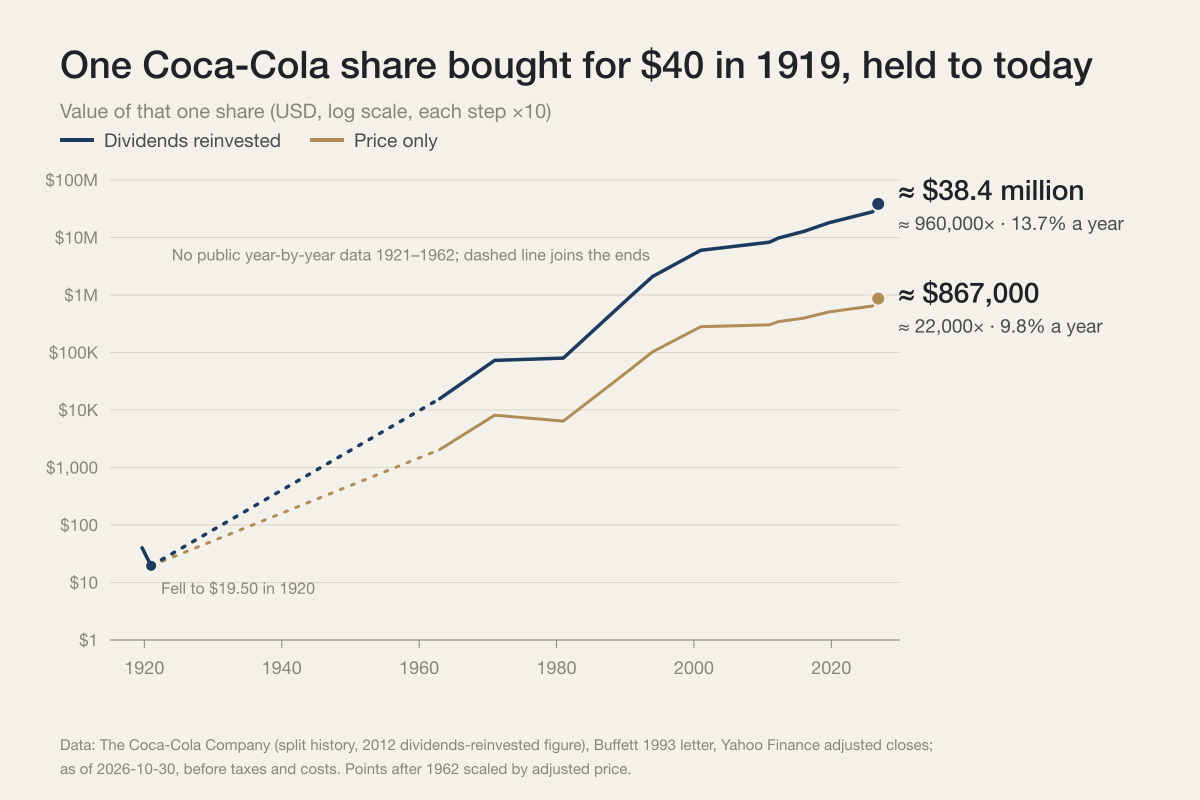
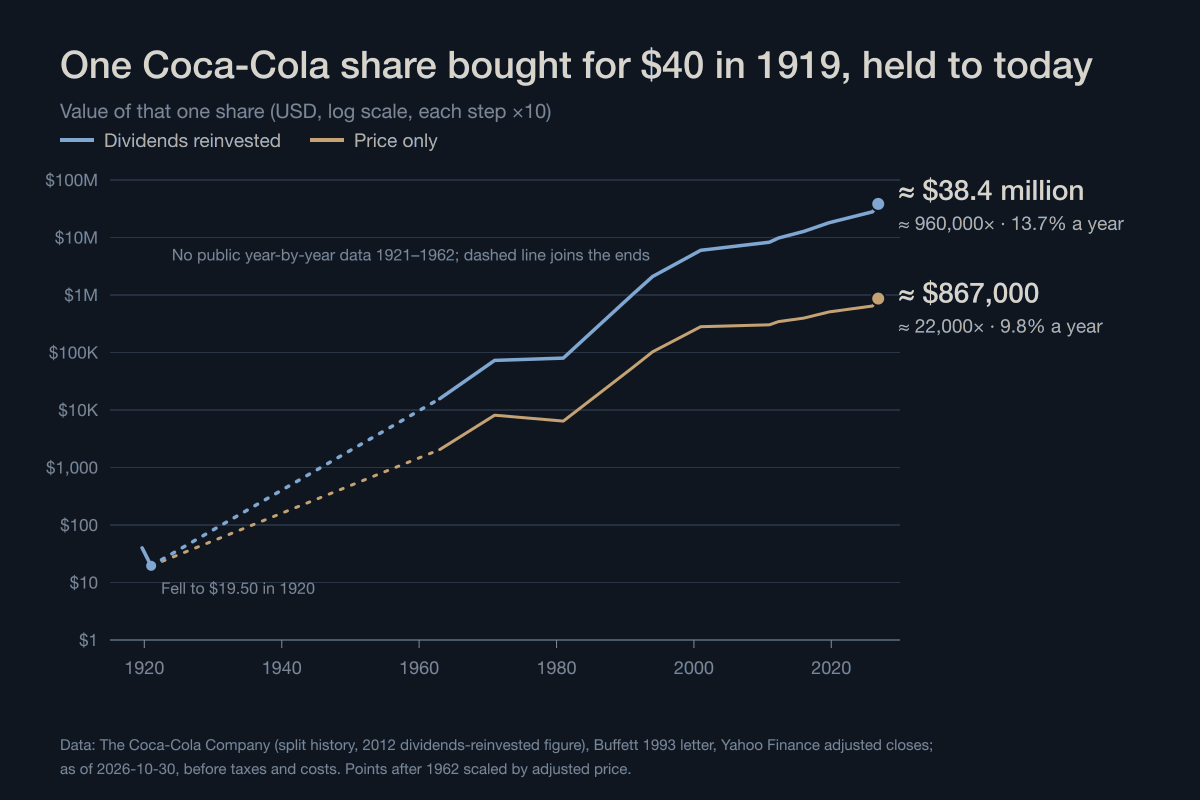
So does compounding this high really exist in the real world? The most famous example is Coca-Cola. It listed in 1919 at $40 a share. Held to today (October 2026), that one share has split into 9,216 shares worth about $867,000 — more than 20,000 times, about 9.8% a year. Reinvest every dividend and it's worth over $38 million — close to a million times, about 13.7% a year. If you have time, pull the data yourself.
7. The safest place
Today, with financial markets so highly developed, 300 years after Newton lost his shirt, everything is different. Lending is no longer a bloody trade.
Only a very few people know the truth: it's all public, yet the people who actually understand it are few and far between.
Why is that? This is exactly why I keep stressing that you should read more, read every day. All of this is written in books. None of it is my original idea, and none of it is made up. Copy and paste any paragraph above into an AI, search it, ask about it, and you'll find quite a few books on the subject.
People always say "investing carries risk." Good heavens — lending in the old days was the truly dangerous thing: the first instinct of someone who couldn't repay was to kill the creditor. It's different now: with developed financial markets and a sound rule of law, things are far more advanced overall than in the dark ages.
The most amazing part: when you lend in the financial market, nobody knows. Everyone just calls you a "trader." When you lend privately, you have to manage property and chase debts; here, you need none of that. When you lend privately, people call you Shylock, or Huang Shiren, the loan-shark villain of Chinese opera; here, you become a "stock god."
We started from why we should invest, then talked about what money is, and finally arrived at this conclusion: why we should buy stocks. And in the end we find that for lenders like us, the safest place is this so-called "risky" securities market.
8. What you learn on paper is never enough
The ideas are all simple — once you've learned them, you could even explain them to your kids. But what you learn on paper always stays shallow; in the end we still have to practice, to start dollar-cost averaging. Otherwise so-called compounding is just compounding in an Excel spreadsheet, not real compounding in your account.
If by now you're feeling stunned, what I want to tell you is: you've barely started. This is basically information I was already certain of five years ago, and for these five years this is exactly what I've done. Over these five years I've kept going, kept learning, kept practicing, and there's knowledge still to come that's even more stunning, the kind that will make your jaw drop. No rush — we have plenty of patience, and I'll share all of it.
Starting with the next post, we'll move on to the strategy and tactics of dollar-cost averaging.