中EN
Dollar-Cost Averaging Means Just Buy
DCA is about buying to a plan, rather than repeatedly guessing the bottom. Extra purchases may not improve returns, while frequent trading adds costs and emotional distractions.
1. What to Do with DCA
Now that we're ready to start dollar-cost averaging, what exactly should we do?
Just one word: buy.
2. Buy Only, Nothing Else
For the long-term DCA plan we're following, the most important thing is to buy to the plan. Don't keep trying to improve it with spur-of-the-moment trades.
That doesn't mean an extra purchase is always wrong, or that DCA is optimal in every situation. The question is: does your extra action have a reliable edge, or do you just feel you'll guess correctly this time?
3. Buy More When It Drops?
We've explained that the same amount of money buys more shares when prices fall. If prices recover later, those cheaply bought shares can help. So many people think: if prices have dropped, shouldn't I buy more to earn even more later?
It's a simple idea, but can you actually do it?
Buying more shares at low prices doesn't mean most of your profits must come from bear markets. The final result also depends on what prices do afterward, and whether you can keep buying.
4. Can You Buy at the Lowest Price?
First, by the time you see the price drop and are able to buy, how do you know this is a low worth committing extra money to?
How intense is the competition in trading? In 2010, network provider Spread Networks opened a dedicated fiber route between Chicago and the New York area, cutting round-trip latency from about 16 milliseconds to about 13. 1
That investment buys execution speed. Even greater speed doesn't tell you where the future bottom will be. As ordinary investors, why should we think that simply seeing a price fall gives us a reliable timing edge?
5. Does Buying Low Guarantee Profit?
Let's say, for the sake of argument, that you did buy at a low price. Does that mean you'll make money?
Not necessarily. The price could rise after you buy, or it could keep falling. Buying below your existing average cost can indeed lower that average. But you've also committed more money and taken on more risk.
If that extra purchase uses up the money set aside for the next few months of DCA, what will you buy with if prices fall further?
6. One More Judgment, One More Distraction
Prices can rise, fall, or stay flat. Those three outcomes don't naturally have equal probabilities. Counting the possible outcomes doesn't tell us our odds of guessing correctly.
The real problem is that, without a reliable way to identify lows, extra purchases can easily follow emotion: a small dip makes you rush in, a bigger drop makes you afraid, and a rally makes you worry about missing out.
Increasing your monthly contribution under a rule you've set in advance, because your income has grown, is one thing. Changing the plan because prices look cheap today or you expect another drop tomorrow is another. The first adjusts how much you can sustainably invest. The second tests your ability to guess prices.
7. What About Multiple Trades?
Frequent trading also brings real costs. Commissions and bid-ask spreads may look small on one trade. Repeated often enough, they eat into returns.
In a study by Barber and Odean, the most actively trading group of households earned 11.4% a year after commissions and estimated bid-ask spreads, compared with 17.9% for the market over the same period. 2
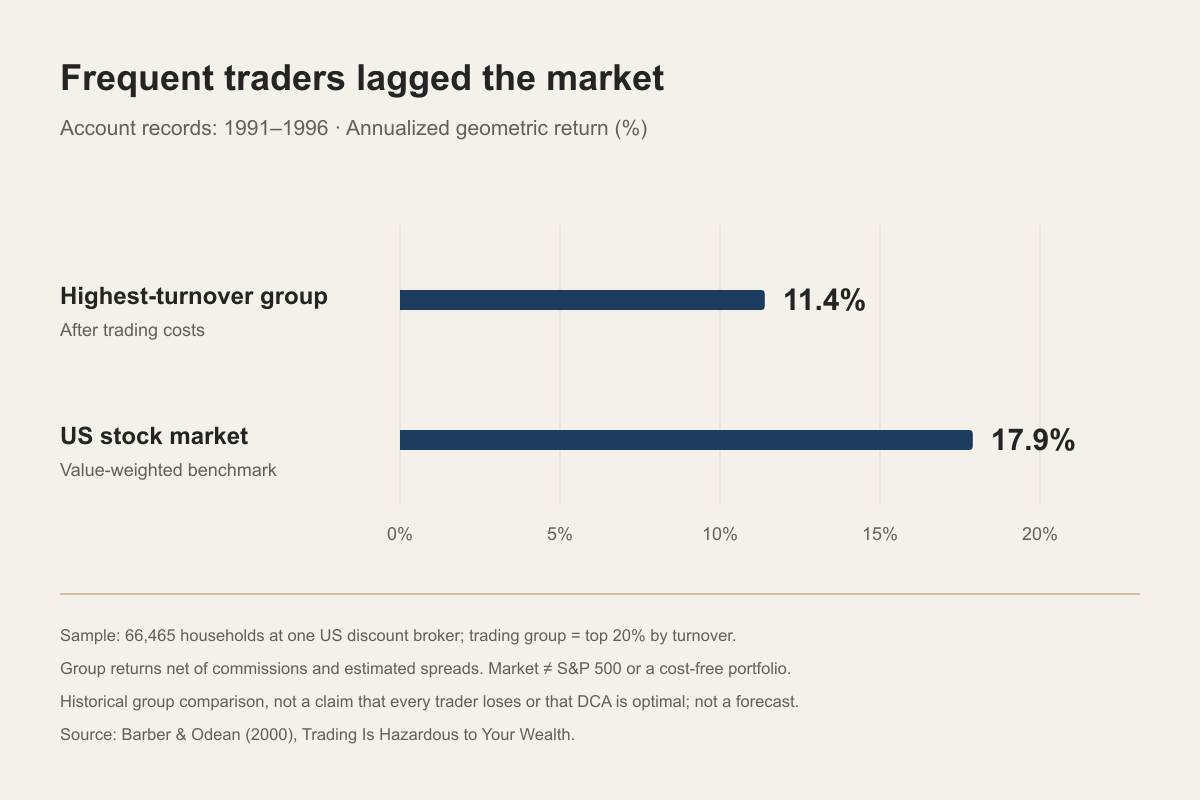
They still made money, but they lagged the market. This doesn't mean everyone who trades more will lose money, or that the study proves DCA is optimal. It's a reminder that being busy trading may not earn you more, while the costs still have to be paid.
In his 2005 letter to shareholders, Buffett wrote:
For investors as a whole, returns decrease as motion increases. 3
He was discussing commissions and management costs borne by investors collectively. He wasn't saying that every additional trade necessarily reduces every individual's return.
8. Every Trick in the Book
And frequent traders don't just trade often. They also:
- Constantly rebalance their portfolios
- Constantly switch sectors
- Constantly change financial products
They use every trick in the book. You can't say they don't work hard. But to find out whether all that effort earns them more, you have to count the costs.
So, for long-term DCA investors like us, first make a plan we can sustain, then buy to that plan. Don't casually turn a way to accumulate assets into a daily price-guessing contest.
9. Next: Why Short-Term Prices Are Hard to Predict
In the next article, we'll discuss why it's difficult to predict short-term stock prices accurately and consistently.
- Spread Networks, 2010 announcement: Spread Networks Sets the New Standard in Trading Latency between Chicago and New York. The route connected Chicago with Carteret, New Jersey, in the New York area. The announced round-trip latency was about 13 milliseconds, compared with about 16 milliseconds previously. ↩
- Brad M. Barber and Terrance Odean (2000), Trading Is Hazardous to Your Wealth: The Common Stock Investment Performance of Individual Investors. The sample covers records for 66,465 households at one US discount broker during 1991–1996; returns are calculated from February 1991 through January 1997. The 11.4% figure is the annualized geometric return of the highest-turnover 20% after commissions and estimated bid-ask spreads; 17.9% is the return of the US value-weighted stock market, not the S&P 500. This is a group comparison in a particular historical sample, not a claim that every trader loses money or a test of whether DCA is optimal. ↩
- Warren Buffett, Berkshire Hathaway 2005 Annual Letter, printed page 19. The surrounding discussion concerns commissions and management costs paid to intermediaries by investors collectively. ↩