中EN
What Is Money
Money is a ledger, and money is a commodity. But at the deepest level, money is the most flexible means of production — and means of production are meant to produce.
1. Before we start, get money straight
Whatever you do, it pays to get the most basic concepts straight first. So before investing, which concept matters most? Money, of course.
What is money, really? Strangely enough, how people see money today is barely different from how people saw it in ancient times — and it is often wrong. As the last post mentioned, most people think money is simply for spending.
Out there, money is usually defined in a few ways.
2. Definition one: money is a ledger
Before writing, people kept records by tying knots in cords, and much of that record-keeping was bookkeeping. Whoever contributed more to society took more money home.
So what is that money to the person holding it? It is a debt society owes them. Whenever they want, they can trade the money for what they want; or they can just keep holding it.
This is exactly how central banks define their own legal tender today. The People's Bank of China, in its white paper Progress of Research & Development of E-CNY in China, puts it plainly:
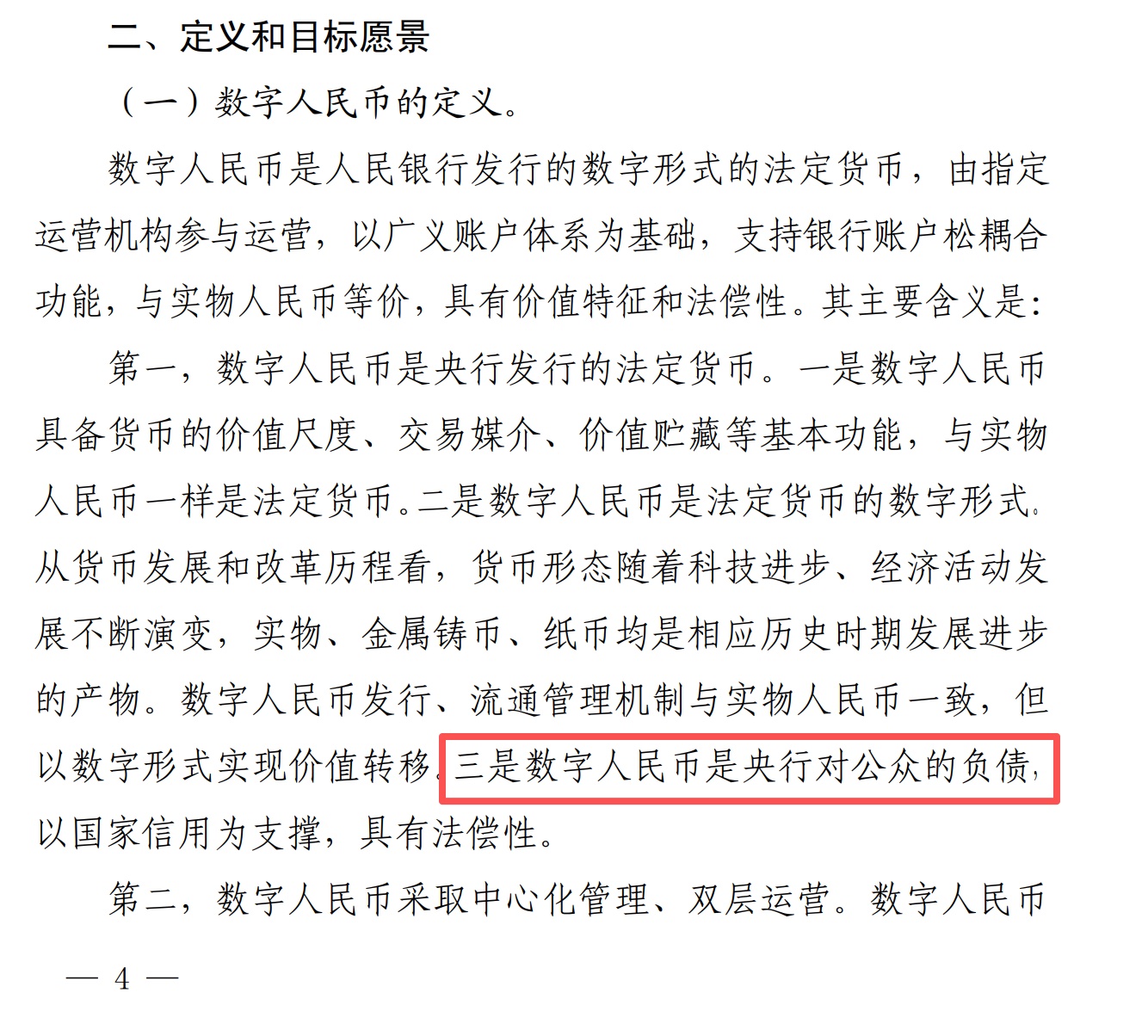
The e-CNY is a liability of the central bank to the public, backed by state credit, and is legal tender.
Read enough history and you'll find the same idea tucked into all sorts of corners.
Seeing money as a ledger leads to a common belief: money is printed by the state. And yes, most money today is printed by the state and backed by its credit. But turn it around: no state does not mean no money. States came after money. Long before there were states, there was money — shells used within a tribe, for example. It's just that today, the state holds a monopoly on keeping the books.
Even so, not all money is printed by governments. Take the Hong Kong dollar: most of its banknotes aren't issued by the Hong Kong government at all, but by three banks — HSBC, Standard Chartered and Bank of China (Hong Kong).
So money doesn't exist because governments do. Apart from scholars, most people get this wrong.
3. Definition two: money is a commodity
This one is easy. Renminbi can be exchanged for US dollars, Hong Kong dollars, euros — money can be swapped for money. To a currency trader, money is just a commodity to buy and sell.
What's the most profitable thing to trade? Money itself, of course. That's why the foreign exchange market is the largest financial market in the world.
It also backs up what the last post said: most people use money to consume, a smaller group uses it to trade, and even fewer use it to produce — people like us.
4. Definition three: money is the most flexible means of production
The two definitions above can be found in textbooks and most academic papers. But money has one more layer, and it's the deepest one:
Money is the most fundamental, most flexible means of production.
What is a means of production? Anything used to produce. Building a house is production, so bricks, cement and sand are means of production. Bricks can only build houses and cement can only bind walls, but money can become bricks, cement, machines — anything production needs. That's why it's the most flexible.
And if money is a means of production, then of course it should be put to work producing.
5. So what is interest?
Putting money to work producing brings up another very important concept: interest.
There are plenty of explanations for interest. The most famous in academia comes from the economist Irving Fisher: interest exists because of human "impatience" — people would rather spend sooner than wait, so if you want them to wait, you have to compensate them.
This "human impatience" shows up in almost every economics book and textbook. But honestly, what on earth is human impatience? And even if we understood it, how would it guide anything we do? It's a very, very strange theory of interest.
In the next post, we'll break with tradition, rethink what interest really is, and look at why it matters so much to us.